

Isfahan Oriental Rug, Persia/Iran, 1940s

Description
Isfahan Oriental Rug, Persia/Iran, 1940s
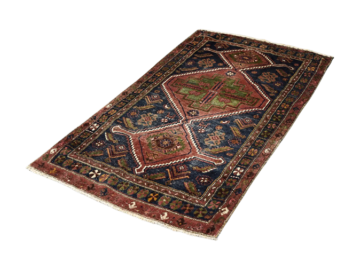
Handwoven Isfahan oriental rug. It was made in the city of Isfahan in central Iran in the 1940s. It is naturally dyed in shades of deep red, blue and yellow. The colours blend into a distinct and varied pattern, whose richness is not concentrated solely in the central area but is dispersed across the entire rug.
Isfahan or Esfahan rugs are among the best-known and most highly regarded types of Persian rugs woven in the city of Isfahan. This city is one of the historic centres of production of very high-quality rugs, which are considered among the finest in the world. Isfahan rugs often feature a symmetrical arrangement of patterns with a central medallion surrounded by intricate floral motifs, leaves and arabesques. The designs draw inspiration from the city’s rich architectural heritage, particularly the mosaics and tiled decoration of its mosques and palaces. Typical colours include deep reds, rich navy, dark blue, gold, and shades of beige and green. These colours are often used in harmonious and sophisticated combinations. Isfahan rugs are typically made from the finest-quality wool, often with the addition of silk, which highlights the details of the design and gives the rug a subtle sheen. The rug’s warp is usually made of silk or cotton, providing durability and precision in weaving. Isfahan rugs are woven using an asymmetrical knot, allowing for a high knot density—often more than 500,000 per square metre—which is synonymous with the highest quality. High knot density allows for the creation of highly precise and intricate designs. Rugs from Isfahan have a long history dating back to the Safavid dynasty (16th–17th centuries), when the art of rug weaving in Isfahan reached its peak. They are considered among the most luxurious and artistically significant Persian rugs, often collected as works of art. Isfahan rugs are often regarded as a symbol of Persian excellence in the art of rug weaving and are sought after around the world by collectors and enthusiasts of luxurious interiors.
The rug is in its original vintage condition. It shows age-related signs of wear and minor pile wear. Before shipping, the rug will undergo professional cleaning and will be ready for use.
The rug features the abrash effect. This is a phenomenon found in traditional handwoven rugs, characterised by subtle variations in shades of the same colour within a single textile. It is most commonly found in Persian, Turkish, Caucasian and other rugs made by hand from natural materials such as wool or silk. Variations in colour may result from the use of natural dyes, which do not always produce a uniform effect, particularly when the wool was dyed in different batches or at different times. As wool ages, it may change colour to varying degrees, which also contributes to the abrash effect. Although this effect could be perceived as an imperfection, it is often valued by collectors and enthusiasts of traditional rugs, as it adds unique character, attests to the authenticity of the handmade craftsmanship, and enhances the rug’s value.
Product information
| Condition | Original - Good [The item shows signs of normal use and material ageing] |
|---|---|
| Country of origin | Asia |
| Years of production | 1940-1949 |
| Style | Oriental |
| Materials | Wool |
| Colour | Multicoloured, Colourless |
Dimensions
| Width | 137 cm |
|---|---|
| Depth | 92 cm |
| Height | 1 cm |
We ship worldwide. International shipping cost is calculated at checkout.
Delivery cost within Poland: 45,00 zł
Estimated delivery time: Within a week