Collection
Op Art
Op art works on the eye before it works on the imagination: geometric arrangements of lines, circles and contrasting colours create the illusion of movement, ripples and depth. The movement emerged in the 1950s and 1960s, and two of its most important artists were born in Poland. You’ll find prints and objects in the spirit of op art in our shop.
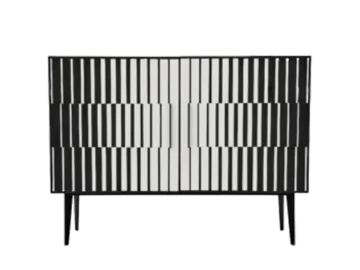
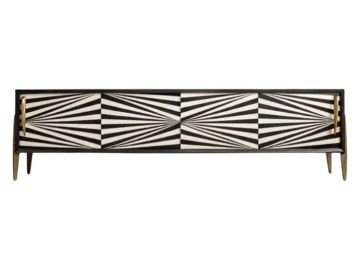
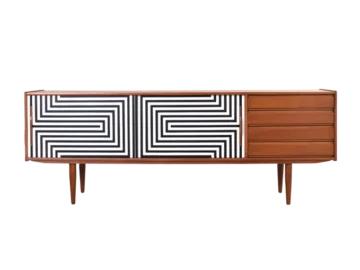
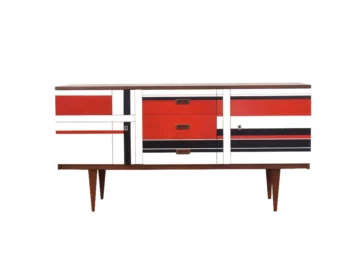
A picture that moves
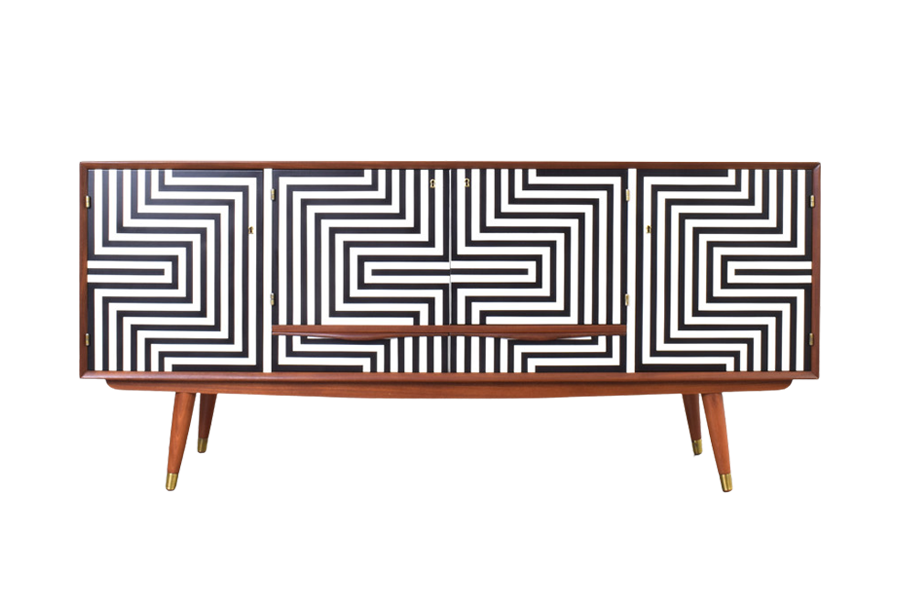
Op art, or optical art, is a branch of geometric abstraction. Its artists depicted nothing at all; they built their pictures from simple, repeated elements – parallel lines, chequerboards, concentric circles and pairs of complementary colours of equal intensity. A precisely planned arrangement makes a flat surface flicker, vibrate or appear to bulge. The subject of the picture is the act of looking itself.
The movement’s roots lie in the Bauhaus and in the research into colour perception carried out there by Josef Albers, among others. Victor Vasarely is regarded as its forerunner: his Zebras of 1937–1938 are made up entirely of black and white stripes. In 1955 the Galerie Denise René in Paris staged Le Mouvement, an exhibition that brought optical and kinetic art together, and from 1961 to 1968 the Paris-based group GRAV explored movement and light. The term “op art” itself first appeared in the American press in 1964, on the occasion of an exhibition of paintings by Julian Stanczak at the Martha Jackson Gallery in New York.
The Responsive Eye
The turning point was The Responsive Eye at the Museum of Modern Art in New York (23 February – 25 April 1965). The curator, William C. Seitz, brought together more than 120 works by nearly a hundred artists, and over 180,000 people saw the exhibition before it toured the United States. The catalogue cover featured Bridget Riley’s Current of 1964.
Riley became the face of the movement. From the early 1960s she painted only in black and white, introduced colour in 1967, and a year later became the first woman to win the International Prize for Painting at the Venice Biennale. Critics were divided – some dismissed op art as a clever trick – but the public embraced it, and fashion and advertising took up its patterns straight away.
Polish artists in the history of op art
Two of the artists in The Responsive Eye were born in Poland. Wojciech Fangor, one of the founders of the Polish School of Posters, presented Studium przestrzeni (Study of Space) in Warsaw with Stanisław Zamecznik as early as 1958 – the first artistic environment in Poland that the viewer could step into. He left the country in 1961, and his blurred, pulsating circles earned him the title of “the great romantic of op art” in the West. In 1970 he became the first Polish artist to have a solo exhibition at the Guggenheim Museum in New York. After returning to Poland, he designed the interiors of the stations on the second line of the Warsaw Metro.
Julian Stanczak was born in 1928 in Borownica. As a child he was deported to a Soviet labour camp, lost the use of his right hand and taught himself to paint with his left. After the war he made his way to the United States and studied under Josef Albers at Yale. It was his 1964 exhibition Optical Paintings that gave the movement its name.
Op art in objects and textiles
Op art left the gallery very quickly. In 1964 Franco Grignani designed the Woolmark logo, based on an optical interlacing of lines. Op art patterns found their way onto fabrics, dresses and shop windows – so fast that Bridget Riley tried to protect her paintings in court from being copied onto textiles. In the 1970s Verner Panton designed geometric fabrics, including for the Swiss company Mira-X; his patterns sit on the border between op art and pop art.
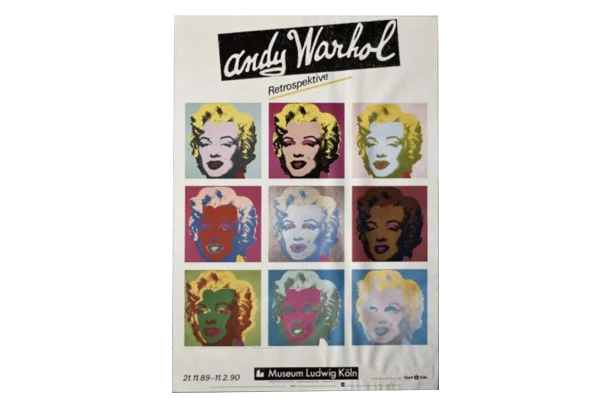
Op art is fundamentally different from pop art: it is abstract and concerned with perception, not mass culture. An op art print works best on a large, calm wall in good light – that is when the illusion of movement is strongest. With prints, check the signature and edition number, which we note for each work.