Collection
Boho Style – Vintage Rattan, Wicker and Natural Fibres
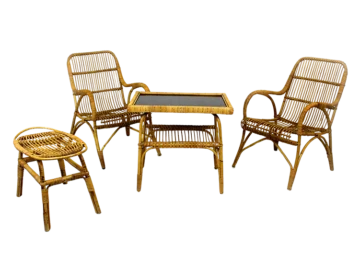
Boho is a way of furnishing rather than an era in design history – a relaxed mix of natural fibres, textiles, plants and objects from different cultures. Its best ingredients, however, are very specific: rattan armchairs, wicker and bamboo furniture, macramé and kilims from the 1950s to the 1970s. You’ll find furniture in this spirit in our shop.
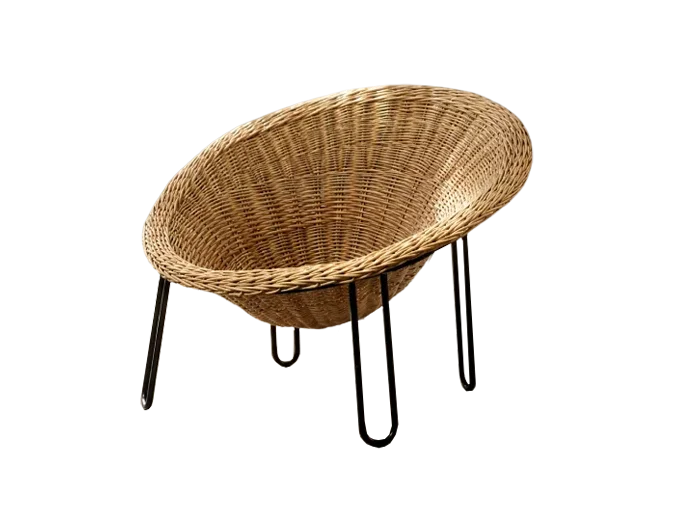
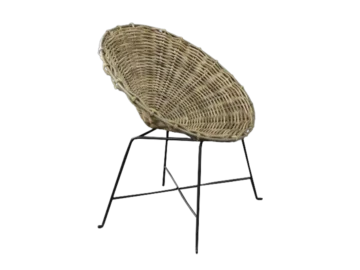
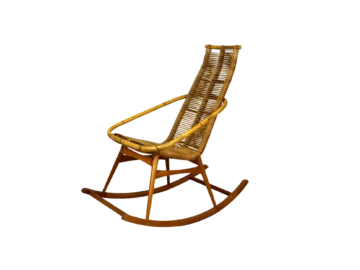
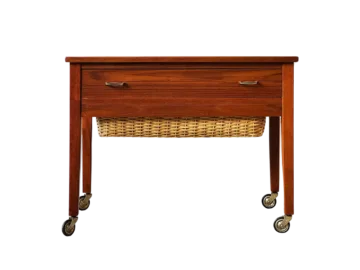
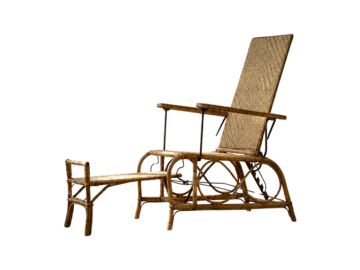
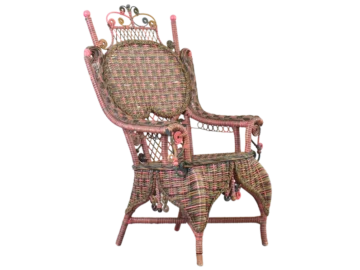
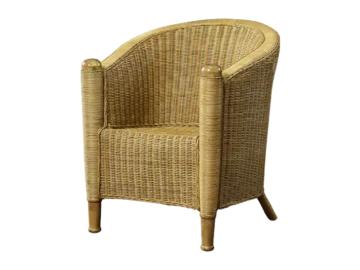
Victorian-style wicker armchair by Heywood-Wakefield, USA, 20th century
Where boho comes from
The word comes from the French bohème – in the 19th century the name given to the Roma, who were thought to have come from Bohemia, and later to artists living outside convention. It was in this second sense that Henri Murger popularised it in his Scènes de la vie de bohème of the 1840s, followed by Puccini in his opera La Bohème (1896). In Polish, the word bohema carries the same meaning.
In the 20th century, the artistic, unconstrained way of life was revived by the counterculture of the 1960s. A 1969 photograph of Talitha Getty in Marrakech is regarded as an icon of this aesthetic. The term “boho-chic”, however, is recent: it appeared in fashion in 2002 and peaked a few years later. A boho interior is therefore a present-day interpretation – built from objects with a very specific history.
Rattan and wicker
Wicker is not a material but a weaving technique. It can be made from willow, rattan, cane, bamboo, or even twisted paper on wire – furniture of this kind, known as Lloyd Loom, was patented by Marshall B. Lloyd in 1917. Rattan comes from climbing palms that grow mainly in South-East Asia, and is exceptionally flexible and strong. Woven furniture was already popular in the Victorian era, as it was considered more hygienic than upholstered pieces.
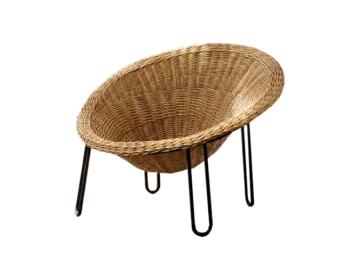
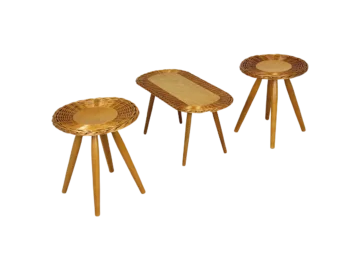
After the Second World War, rattan entered the world of design. In 1950 Franco Albini designed the Margherita armchair with Gino Colombini – a sculptural form in malacca cane, made by Vittorio Bonacina of Lurago d’Erba and now in the collection of the Montreal Museum of Fine Arts. Albini, a Milanese rationalist, turned to cheap, natural materials in a time of post-war shortages, and his designs showed that rattan could be a modern material. In Poland, the wickerwork tradition is centred on Rudnik nad Sanem, known as the Polish capital of wicker.
The peacock chair and the 1970s
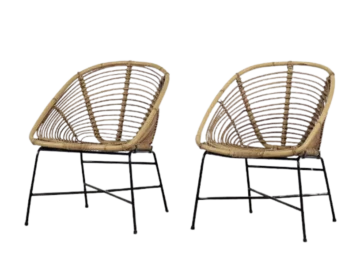
The most recognisable piece of boho furniture is the peacock chair, with its tall, fan-shaped back. Its history is less romantic than its form suggests: in the early 20th century it was woven by inmates in the workshops of Bilibid Prison in Manila, during the American administration of the Philippines, and in 1915 it was shown at the world’s fair in San Francisco. In the 1960s and 1970s the chair became a cultural icon: Huey P. Newton sits in one in a famous 1967 photograph, and it appeared in The Addams Family and on album covers.
The 1970s also brought a revival of macramé – an old knotting technique, known in Europe since the 17th century – in the form of wall hangings and plant hangers. Macramé went out of fashion in the early 1980s and returned in the late 2010s.
How to build a boho interior with vintage
A good boho interior is not a random collection of decorations. It rests on a few strong pieces in natural materials – a rattan armchair, a wicker side table, a bamboo shelf – combined with textiles, ceramics and plants. Period furniture has the edge over new pieces here: a denser weave, thicker rattan and a patina that cannot be faked.
With woven furniture, check the condition of the weave and the frame joints – small cracks in individual strands can be repaired, and regular care with a slightly damp cloth keeps rattan from drying out. We describe the material, condition and any restoration for every piece.