Collection
Vintage Wall Clocks
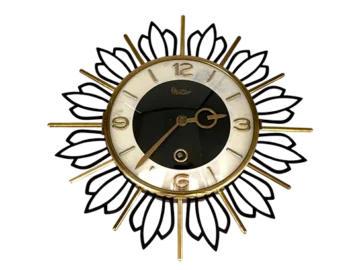
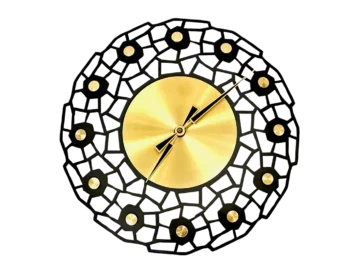
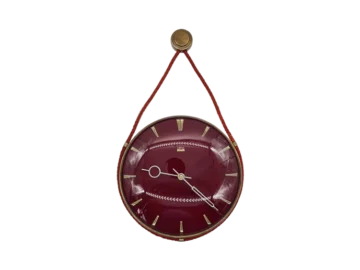
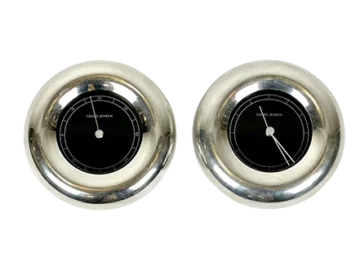
Vintage wall clocks from the 1960s are decoration that also tells the time – most often in the shape of a sun, with rays of metal or wood. The collection features original clocks from Germany from the 1960s and 70s. Other clocks are in our vintage clocks category.
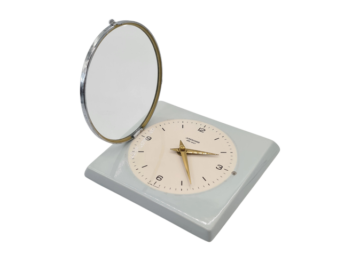
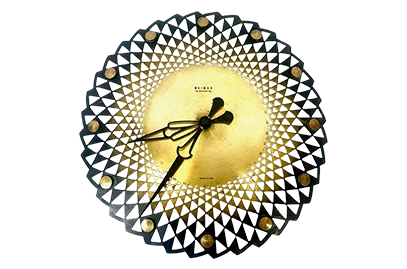
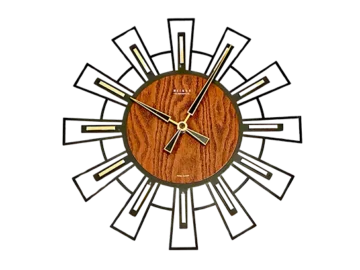
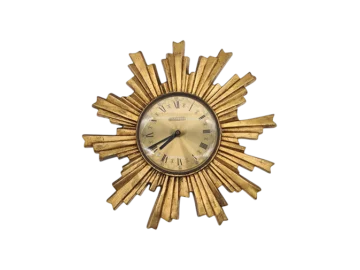
The clock as wall decoration
In 1949 the American company Howard Miller introduced the Ball Clock from George Nelson’s office – a clock without a case, with balls on rods in place of numerals. The design showed that a clock could be first and foremost a decorative object, and it launched the fashion for sunburst clocks. In the 1950s and 60s they were made across Europe, and in particularly large numbers in Germany, where the clockmaking industry had a long tradition.
A sunburst clock was usually hung above a sofa, sideboard or fireplace – where today one would hang a picture. It suits interiors with furniture from the same era, but it also brings life to an entirely contemporary blank wall.
Sunburst clocks from Germany
A sunburst clock has a round dial surrounded by rays of metal or wood. This collection features clocks from Germany, including Weimar, Electrica, Müller and UPG Halle. Some of the makers’ names point to centres in the former GDR, and the rays are made of metal – usually brass, or chromed or painted steel. The clocks vary in diameter: from compact pieces to large ones of several tens of centimetres that act as the focal point of a wall.
Movement
Clocks from this period had wind-up or electric movements; in many, the movement was later replaced with a battery-powered quartz one. This is a common change that does not affect the clock’s appearance. The type of movement and its condition are given in each clock’s description.
How to hang a sunburst clock
A sun-shaped wall clock needs free space around its rays – it looks best alone on a wall or as the centrepiece of an arrangement. Hang it with the centre of the dial at eye level, about 150–160 cm from the floor, or 20–30 cm above the top edge of a piece of furniture. The clock’s diameter is listed in the Dimensions tab.