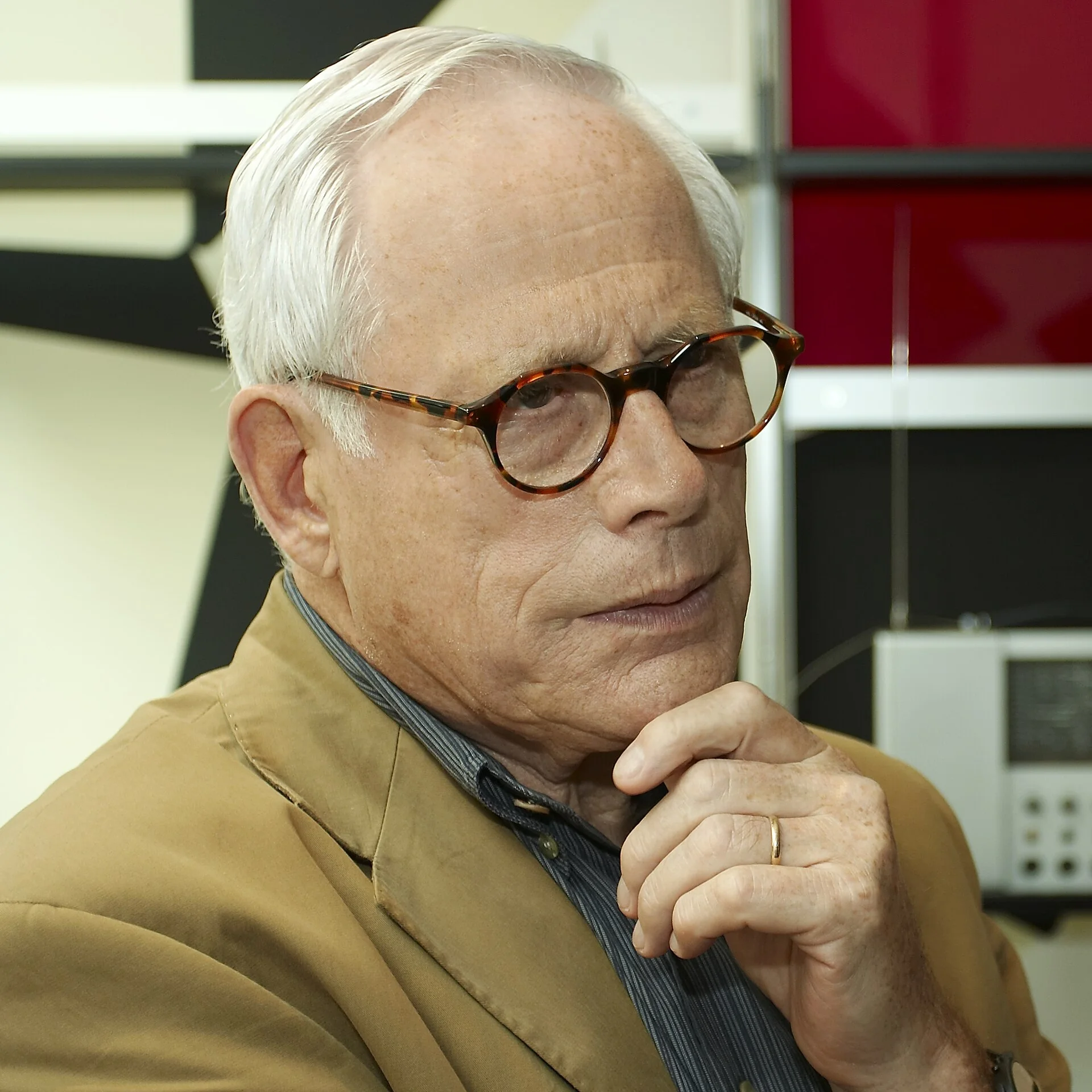
Designer · Germany · b. 1932
Dieter Rams
Dieter Rams (b. 1932) – German industrial designer, head of design at Braun from 1961 to 1997, designer of the 606 bookcase for Vitsœ (1960).
We have no pieces designed by Dieter Rams available right now.
New pieces arrive every day. See what we have offered before below, or browse the shop.
About the designer
- Lifetime
- b. 1932
- Country
- Germany
Dieter Rams was born on 20 May 1932 in Wiesbaden. He studied architecture and interior architecture at Wiesbaden School of Art and completed a cabinetmaking apprenticeship; after graduating in 1953, he worked for Otto Apel. In 1955, he began working for Braun, where he took charge of the design department in 1961; he remained there until his retirement in 1997.
In 1956, he designed the SK 4 radiogram together with Hans Gugelot. For Vitsœ, he created the 606 Universal Shelving System (1960) and the 620 seating programme; the 606 system is in the MoMA collection, while the 620 is held in the Victoria and Albert Museum collection. He formulated ten principles of good design, summarised by the phrase ‘less, but better’.
He received the title Honorary RDI (1968), an honorary doctorate from the Royal College of Art (1989), the World Design Medal from IDSA (1996) and the Compasso d’Oro for lifetime achievement (2014). His work was presented in the exhibition ‘Less and More’ (2008–2012, including at the Design Museum in London and SFMOMA), and in 2016 Vitra Design Museum presented the exhibition ‘Modular World’.
Designs created with his involvement for Braun included TP 1 (1959), RT 20 and T 1000 (1963), and the Domino lighter (1970); the company’s designs received the Grand Prix Triennale in Milan in 1957 and 1960. Vitsœ reissued the RZ 62 armchair from the 620 programme (1962) in 2006.
Key designs
-
SK 4
radiogram, with H. Gugelot
-
606 Universal Shelving System
shelving system (MoMA)
-
620 (RZ 62)
seating programme (V&A); reissued 2006
-
Domino
lighter