
Manufacturer · Austria · Vienna · 1898–1987
Werkstätte Hagenauer
Werkstätte Hagenauer (1898–1987) – Viennese workshop of the Hagenauer family, known for brass animal figures and Art Deco objects.
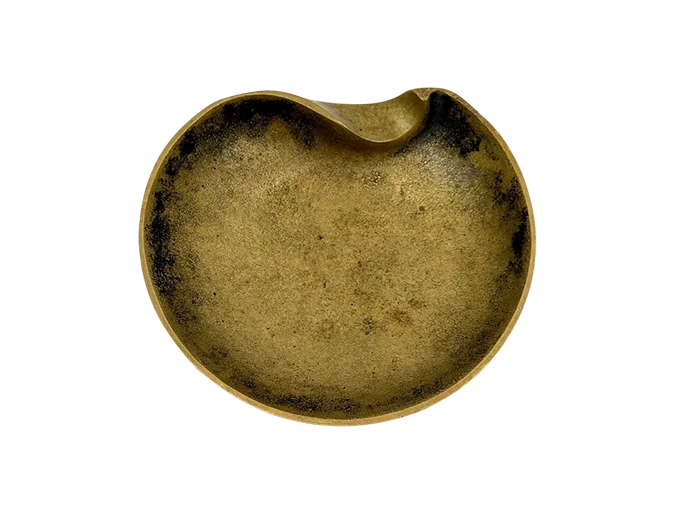
Ashtray, designed by Franz Hagenauer, Hagenauer Workshops, Austria, 1950s
About the manufacturer
- Years active
- 1898–1987
- Country
- Austria
- Location
- Vienna
The workshop was founded in Vienna in 1898 by Carl Hagenauer (1872–1928), a chaser and master metalworker (Gürtlermeister) who trained at the Viennese silverware manufacturer Würbel & Czokally and qualified as a goldsmith. The company operated under the name Werkstätte Hagenauer Wien, abbreviated to wHw.
In 1919, the founder’s son, Karl Hagenauer (1898–1956), joined the company. He was a graduate of the Vienna School of Arts and Crafts, where he studied under Josef Hoffmann and Oskar Strnad; he also designed for Wiener Werkstätte. After his father’s death in 1928, he ran the workshop together with his siblings, Grete and Franz. Karl designed the company mark, wHw in a circle, registered in 1927. Franz Hagenauer (1906–1986) was a sculptor specialising in sheet-metal work, while Julius Jirasek designed furniture and furnishings for the company from 1930 to 1960. The workshop also produced objects based on designs by Josef Hoffmann and Otto Prutscher.
The workshop produced brass figurines, stylised animals and fantastical creatures, as well as mirrors, cigar cutters, ashtrays, candlesticks, corkscrews, bookends and lamp bases, often shaped as athletes or animals. An important customer in the United States was the New York gallerist Rena Rosenthal. The company won medals in Paris in 1925 and 1937 and an Austrian state award in 1934, and opened a shop on Opernring in 1938. The collections of the Museum of Applied Arts in Vienna (MAK) include its candlesticks and bird- and dog-shaped ashtrays.
After the Second World War, the workshop produced metal objects and furniture needed for reconstruction, returning to decorative goods in the 1950s. After Karl’s death in 1956, Franz ran the workshop, while in its final years it was managed by his pupil Karl Schmidt. The workshop closed in 1987, when Schmidt established his own workshop in Vienna.
