Designer · posters · Spain · 1893–1983
Joan Miró
Joan Miró (1893–1983) – Catalan painter, sculptor and printmaker associated with Surrealism, known for numerous lithographs and etchings.
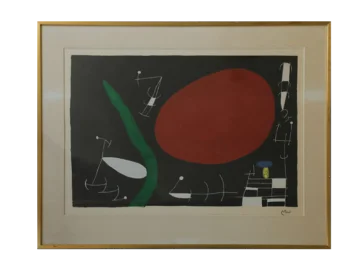
Colour lithograph, Soleil et Étincelles, Joan Miró, 1960s
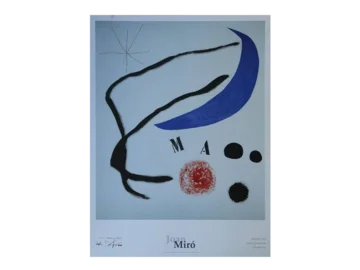
Poster Poema I, 1968, Joan Miró, Barcelona, 1995
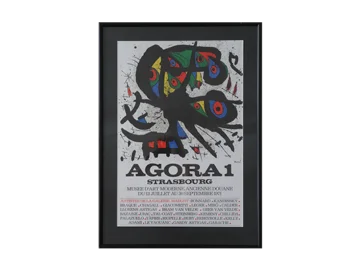
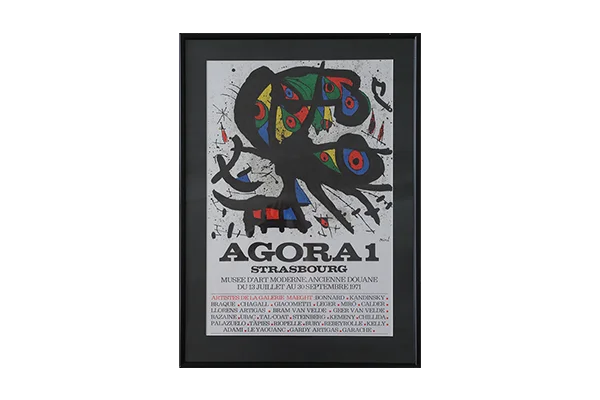
Colour lithograph, Joan Miró, Agora I, 1971
About the designer
- Lifetime
- 1893–1983
- Country
- Spain
Joan Miró was born on 20 April 1893 in Barcelona and died on 25 December 1983 in Palma de Mallorca. He studied at Barcelona's Llotja school (from 1907), at the school of Francesc Galí and at the Cercle Artístic de Sant Lluc. He held his first solo exhibition in 1918 at Galeries Dalmau in Barcelona, moved to Paris in 1920 and became associated with the Surrealist group in 1924. His best-known works include “The Farm” (1921–1922), “Harlequin’s Carnival” (1924–1925), the gouache series “Constellations” (1940–1941) and the ceramic walls of the Moon and Sun at the UNESCO headquarters in Paris.
According to Fundació Joan Miró, he made his first prints in Paris in the 1930s and in 1947 developed his printmaking technique under Stanley William Hayter in New York; after the war, his graphic work was supported by the art dealer Aimé Maeght. He worked with lithography, etching, aquatint, drypoint and engraving. The foundation’s collection includes the series “Black and Red” (1938), “Series III” (1952–1953) and “Yellow and Green” (1961). He made lithographic prints, among other places, at the Mourlot printing house in Paris.
He received, among other distinctions, the Guggenheim International Award (1958) and Spain’s Gold Medal of Fine Arts (1980). His work is presented by Fundació Joan Miró in Barcelona (1975) and Fundació Pilar i Joan Miró in Palma (1981); retrospectives were held, among others, at Tate Modern (2011), Grand Palais (2018) and MoMA (2019).