Collection
Polish Mid-Century Glass – Vases and Art Glass from Polish Glassworks
Polish mid-century glass comes from the country’s glassworks between 1945 and 1989: pressed vases and bowls from Ząbkowice, hand-formed glass from Szczytna and Polanica, crystal from Lower Silesia and studio glass from the Glass Institute in Kraków. We name the glassworks and designer only when a label, signature or documented design confirms them. Venetian glass of the same period can be found in the Murano Glass collection.
Glassworks, the academy and the Glass Institute
After 1945 Poland’s glassworks were nationalised, and in the 1950s their designs were shaped mainly by competitions run by the Institute of Industrial Design. The breakthrough came with graduates of the Wrocław State College of Fine Arts (today’s Academy of Fine Arts), where most glassworks designers of the period trained in the Faculty of Ceramics and Glass.
In the early 1960s designers joined the factories permanently. At Ząbkowice the design department was set up by Jan Sylwester Drost; at the Sudety works in Szczytna Zbigniew Horbowy – Poland’s first graduate in glass design – worked from 1959; and at Krosno the chief designers were Wszewłod Sarnecki (1964–1973) and Jerzy Maraj (1971–1984). In 1969 a design studio opened at the Kraków glassworks on Lipowa Street – from 1972 a branch of the Glass Institute – under Jerzy Słuczan-Orkusz, and from 1973 design for the household-glass works was coordinated by Vitropol in Sosnowiec.
Ząbkowice: pressed glass as design
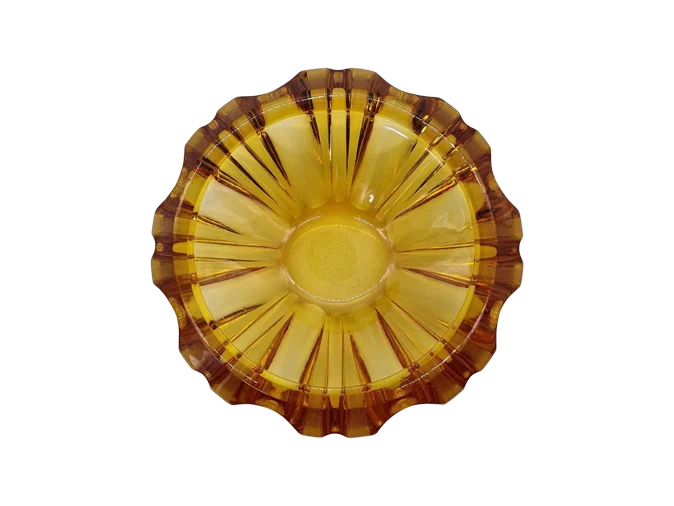
The Ząbkowice household glassworks in Ząbkowice Będzińskie (today part of Dąbrowa Górnicza) had pressed glass since the early 20th century, but it was the design studio, active from 1960, that turned it into a designer’s material. Pressing forces molten glass into a metal mould with a plunger, so the inner shape does not follow the outer one – which allows thick, sculptural walls. The Drosts deliberately used what had been seen as the technique’s flaws.
The best-known series are Diatret (1973), Asteroid (1975) and Radiant (1976) by Jan Sylwester Drost, and Cora (1978) by Eryka Trzewik-Drost. Asteroid – glass decorated with small spheres – won a gold medal at the Glass Triennial in Jablonec nad Nisou in 1976 and in 1984 entered the permanent display of the Corning Museum of Glass. In the 1970s the works mass-produced coloured glass; in 1979 it absorbed the Staszic glassworks, where Ludwik Fiedorowicz designed jugs, vases and bowls, including in ruby red.
Hand-formed glass and crystal: Szczytna, Polanica, Zawiercie, Tarnowiec
Alongside pressed glass, glass was formed by hand at the furnace. At the Sudety works Zbigniew Horbowy developed antico glass in the 1960s – full of air bubbles produced with a special powder – which became a major commercial success. From 1974 he was artistic director of the Barbara glassworks in Polanica-Zdrój. At Zawiercie, Józef Podlasek (1967–1995) designed antico glass in intense amber with sparser bubbles.
The Tarnowiec works near Jasło, founded in 1975, specialised in coloured glass; Jerzy Słuczan-Orkusz designed for it from 1982 to 1991. Lead crystal – containing at least 20% lead oxide, soft and highly refractive – was made mainly by Violetta in Stronie Śląskie, Julia in Piechowice and Irena in Inowrocław, largely for export.
How to identify Polish mid-century glass
The surest proof of origin is an original label. Ząbkowice and Staszic pieces carried a label with a black square, a double silver letter “Z” and the name of the works. Glass from the Kraków Glass Institute bears a mark of a dragon blowing a bubble, and Słuczan-Orkusz’s designs have catalogue codes of a letter and a number (e.g. B-458).
Without a label, form and technique help: the pressed Ząbkowice series are well documented in museum collections, and antico glass from Szczytna and Zawiercie differs in bubble density and colour. Many shapes were, however, produced for years and in different colours, and similar shapes were made in other countries too. So an unmarked piece is described as attributed to a glassworks – not as certain – and we do not use trade names that sources do not confirm. Polish 20th-century glass can be seen at the National Museum in Wrocław, which holds over 200 pieces donated by the Ząbkowice works.