Collection
Murano Glass – Original Venetian Art Glass
Murano glass comes from the glassworks on the Venetian island of Murano, where glassmaking was concentrated at the end of the 13th century. This collection brings together 20th-century vases, bowls, ashtrays, lamps and chandeliers – from signed pieces by renowned glassworks to anonymous sommerso glass. We describe each piece as far as its marks allow: the glassworks and designer are named only when they can be confirmed. Polish glass of the same period can be found in the Polish Mid-Century Glass collection.
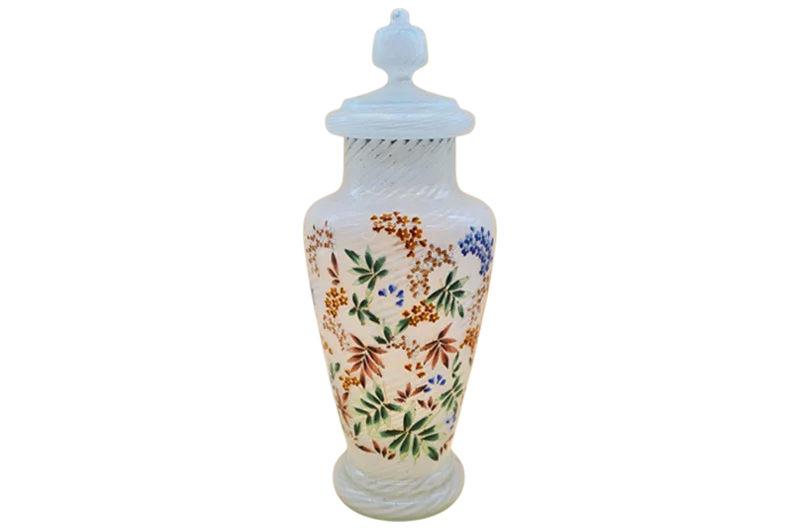
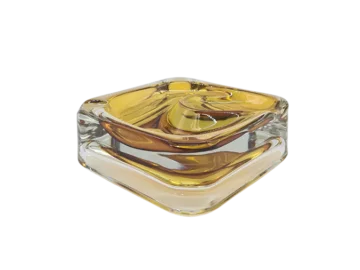
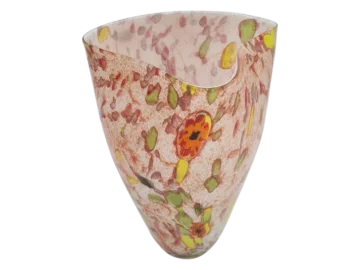
An island of glassmakers since 1291
Glassmakers worked in Venice from at least the 13th century, and around 1271 their guild statute already forbade taking the secrets of the trade out of the city. A law of 8 November 1291 moved most furnaces to the nearby island of Murano – because of the fire risk in the timber-built city, but also to protect the technology. Glassmakers enjoyed privileges (glassmakers’ daughters could marry patricians without losing status), but they were not allowed to leave the Republic.
In the 15th century Murano produced cristallo – almost colourless glass attributed to Angelo Barovier – as well as lattimo, a milky glass imitating Chinese porcelain, and calcedonio, imitating agate. In the 18th century Giuseppe Briati made famous chandeliers with hundreds of glass flowers and leaves; his chandelier of around 1730 hangs in Venice’s Ca’ Rezzonico. After the fall of the Republic in 1797 the glassworks declined, and revival came only in the second half of the 19th century: the Museo del Vetro (1861), a glassmaking school and the firm of Antonio Salviati, which made mosaics for Westminster Abbey among others.
The 20th century: Venini, Seguso, Barovier & Toso
Modern Murano glass begins in 1921, when Paolo Venini and Giacomo Cappellin founded the glassworks that grew into Venini. Its designers included Napoleone Martinuzzi (pulegoso glass, 1928), Carlo Scarpa (1932–1947), Gio Ponti and Fulvio Bianconi, creator of the Fazzoletto vase (1949). At Seguso Vetri d’Arte the artistic director from 1934 to 1963 was Flavio Poli, who made the sommerso technique famous and won the Compasso d’Oro in 1954.
Barovier & Toso descends from a glassmaking family documented since 1324; Ercole Barovier designed series of coloured glass for it from 1920. Alfredo Barbini developed massive, solid glass, and the Salviati firm is represented by Sergio Asti’s Marco vase (Compasso d’Oro 1962). Murano lamps and chandeliers were made by Vistosi (the Giogali lamp, 1967), Venini and Mazzega, among others.
Techniques: sommerso, filigrana, murrina, pulegoso
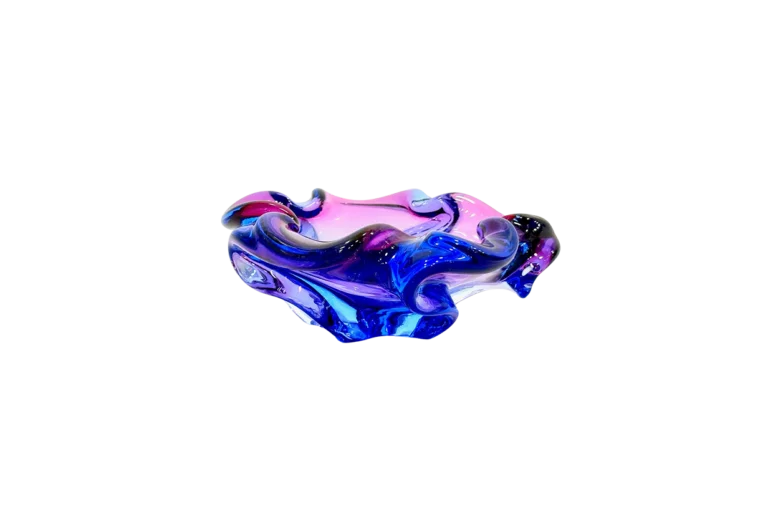
Sommerso (“submerged”) consists of several thick, transparent layers of glass in different colours, built up by successive dipping into crucibles – the technique most often found in glass of the 1950s and 60s. Filigrana is decoration made from rods containing threads of milky or coloured glass: in reticello the threads form a fine net, in zanfirico they twist in spirals. Murrina is slices of glass cane fused into a sheet and shaped, and millefiori is a variant with concentric layers, resembling a meadow of flowers.
Pulegoso, invented by Martinuzzi for Venini, is opaque glass full of bubbles with a rough surface. Incalmo joins separately blown parts into one piece while hot. Battuto is a surface cut into small facets that recall hammered metal, scavo is matt and rough like excavated glass, and avventurina contains glittering copper crystals.
How to recognise original Murano glass
Imitations are estimated to make up as much as 40–45% of the “Murano glass” market. The only legally recognised mark of origin is Vetro Artistico® Murano, established by a Veneto regional law in 1994 and managed since 2001 by the Consorzio Promovetro. It is a label with a serial number, voluntary and used by a few dozen glassworks. Vintage glass made before 1994 cannot carry it – so its absence proves nothing.
For period glass, original labels and signatures engraved in the base help, such as “Venini Murano Italia”. A signature is not proof in itself, though: the Victoria and Albert Museum describes a vase whose “Venini Murano” inscription was probably added much later. A pontil mark on the base confirms hand-forming, but not origin on Murano as such. That is why we describe an unmarked piece in general terms – as Murano glass made in a given technique – and name a designer only when the attribution is confirmed.