Manufacturer · furniture · Austria / Germany · Vienna, Frankenberg (Eder) · est. 1819
Thonet
Thonet – Michael Thonet’s company, pioneer of industrial steam bending and creator of chair no. 14; its Radomsko factory gave rise to post-war Fameg.
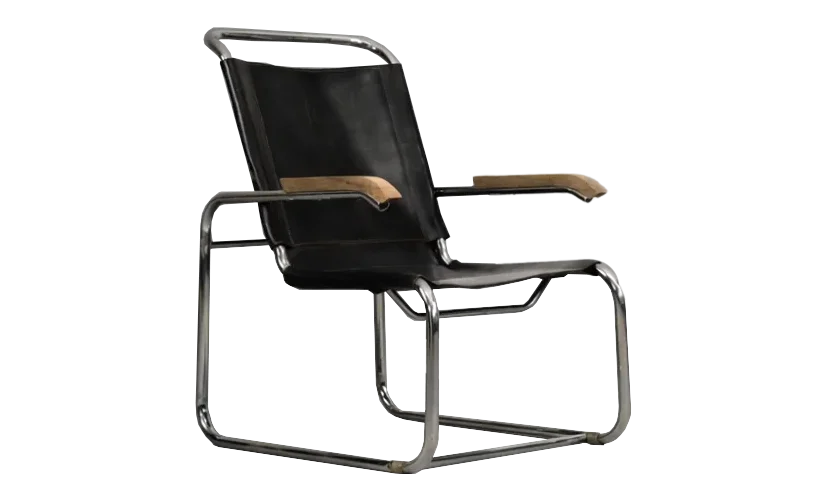
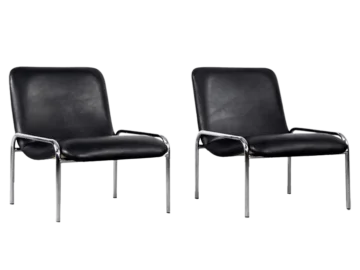
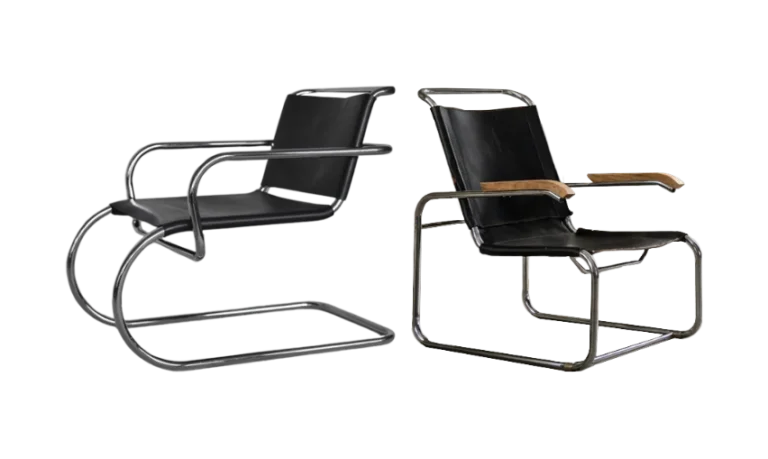
B35 Leather Armchair, Designed by Marcel Breuer, Thonet, Germany, 1930s
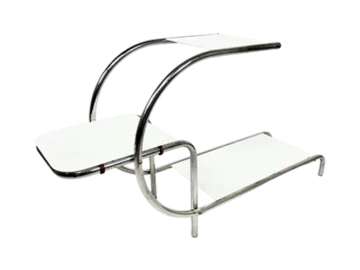
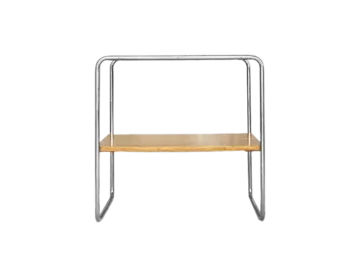
Plant stand, designed by Emile Guyot, Thonet, Czechoslovakia, 1950s
About the manufacturer
- Years active
- est. 1819
- Country
- Austria / Germany
- Location
- Vienna, Frankenberg (Eder)
- Designers
- Marcel Breuer, Mart Stam
Michael Thonet (1796–1871), a cabinetmaker from Boppard on the Rhine, opened his own workshop in 1819 and began experimenting with bending wood. In 1841, at an exhibition in Koblenz, he met Prince Metternich, who persuaded him to move to Vienna. In 1842, Thonet received a privilege there to bend wood “chemically and mechanically”, and in 1849 founded his own company – Café Daum was among the first establishments furnished entirely with his chairs. In 1853 he transferred the business to his five sons, after which it operated as Gebrüder Thonet. The technology was based on bending solid beech in hot steam.
In 1859, chair no. 14 was created, known as the Vienna café chair. By 1930, approximately 50 million examples had been produced; 36 disassembled chairs fit into a crate with a capacity of one cubic metre. In 1867, the chair won a gold medal at the World's Fair in Paris, and today it is produced as model 214.
Factories were built close to beech forests: in Moravia (Koryčany, Bystřice pod Hostýnem), in what is now Slovakia, and in 1880–1881 in Nowo-Radomsk, now Radomsko. In 1889, a plant was established in Frankenberg, Hesse. After merging with the Mundus concern, which had previously absorbed the Vienna-based company Jacob & Josef Kohn, Thonet-Mundus was established in the early 1920s – according to Wikipedia, the largest furniture manufacturer in the world. The concern also included the factory in Jasienica, founded in 1881 by Josef Hofmann, now known as Paged.
The Radomsko factory was nationalised after 1945 as Furniture Factory No. 1; in 1948, construction began there on a new plant called “Fameg” (from FAbryka MEbli Giętych). Therefore, bent chairs and armchairs from Radomsko made during the PRL period are products of FAMEG Radomsko, not Thonet, although they derive from the same tradition and often from the same halls.
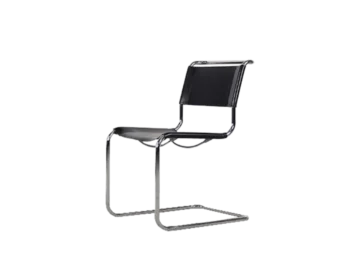
At the end of the 1920s, Thonet introduced furniture made from tubular steel: Mart Stam’s cantilever chair S 33 (1926), Ludwig Mies van der Rohe’s S 533 (1927), and Marcel Breuer’s S 32 and S 64 – later known as the Cesca chair. In the 1930s, the company was the world’s largest manufacturer of tubular steel furniture.
After 1945, the Thonet family lost its plants in Czechoslovakia, Poland and Hungary. The rebuilt factory in Frankenberg became the headquarters; the plant in Bystřice is operated by the Czech company TON, which is unrelated to Thonet GmbH. In the 1960s, Thonet produced, among others, designs by Verner Panton (S-Chair, 1965). In 1976, the company split into German and Austrian parts, and in 1989 Museum Thonet opened in Frankenberg.
More furniture from this circle can be found in the Bauhaus and PRL Chairs collections.
How to identify pieces from this manufacturer
Period furniture bears the burned-in mark “Thonet” and paper labels “Thonet Wien”. The trademark on the label was introduced in 1888, so a piece with such a designation cannot be older (Australian Museum). Bent furniture from Radomsko and Jasienica produced after 1945 is made by Fameg and Paged – we describe it under the names of these manufacturers, not as Thonet.