MAG · Opinion
What’s next?
To anticipate upcoming trends, I look to the past, following the way styles took shape over the course of the last century. Each decade has characteristics that set it apart from the others—styles naturally overlapped, making it difficult to separate them with a clear line. But when I say the 1920s, I think of Art Déco; when I say the 1930s, I think of Bauhaus; when I say the 1950s, I think of Mid-Century Modern. Music, fashion, the visual arts, and architecture—all these fields develop in parallel with the events of their time, reflecting the state of the world.
It is impossible to overlook the enormous influence that one of the most important events of the 20th century—the splitting of the atom (1938)—had on aesthetics. During the Cold War, the atom not only frightened people but also filled them with optimism. People believed in inexhaustible supplies of energy from the atom, which would power their cars and light their homes; it would be a cheap source of power driving factories and producing vast quantities of goods available to everyone. In writing this, I have in mind the economic situation of the free world, where people had no shortage of freedom to act, illustrated particularly well in the United States by Populuxe aesthetics (popular + luxurious).
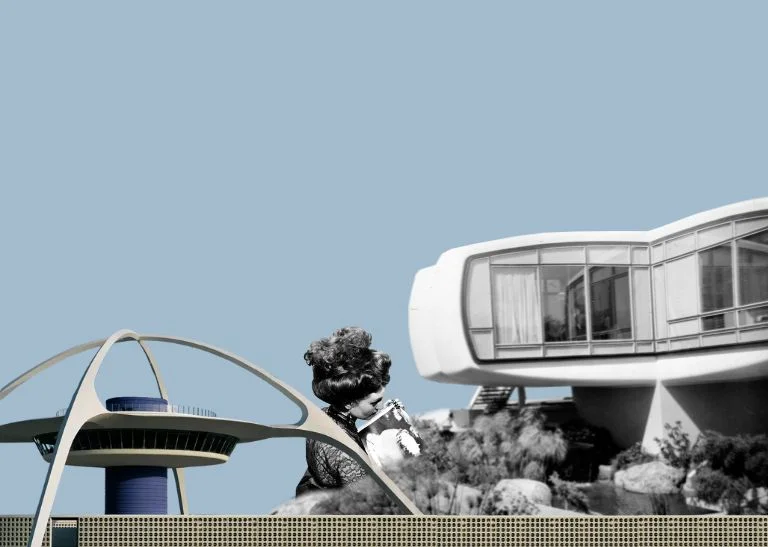
Contemporary creators drew inspiration, among other things, from the exciting vision of conquering, and even colonizing, space. In architecture, this was expressed by the Monsanto House of the Future built on the grounds of Disneyland in California in 1957, or by the Theme Building designed for LAX airport and opened in 1961. That same year, the genre of classic science fiction was enriched by Solaris by Stanisław Lem. A few years later, Quasar Khanh created the Aerospace line—electrically welded PVC furniture—and the cube-shaped Cube Car, which had inflatable seats. The Djinn chair, designed by Olivier Mourgue, became iconic after appearing in 2001: A Space Odyssey by Kubrick’s; after watching it, David Bowie released Space Oddity —and all this before Apollo 11 landed successfully.
After reaching the moon (1969), people in the 1970s could have focused on planet Earth with a clear conscience. They drew inspiration from it, for example bringing a nature-inspired palette into interiors and fashion; the landscape and architectural projects were harmonious, and the popularity of the hippie movement did not wane. Spiral Jetty by Robert Smithson put the term Land Art into textbooks. Alongside this pro-Earth trend, simple forms continued to be combined with vivid colours, but seat heights moved closer to the ground. Mario Bellini designed the famous Camaleonda modular sofa, and Ligne Roset began producing Togo in 1973.
Nowadays, as I try to determine where our little boat lies on the ocean of style, I have to remember that in 1977 the development of civilization in the industrial age was coming to an end, and the Apple II—the first personal computer—went on sale. It turns out, then, that the bold and eclectic 1980s and 1990s were simply convulsions of the industrial world flirting with the digital world. The global transformation into an information society was so significant that it is cited as one of the reasons for the collapse of the Soviet Union (!). Over the past three decades, almost everyone has gained open access to the internet, and in 2007 the first iPhone was launched. Even today, fast fashion can barely keep up with social media; to stay current, we use enormous amounts of energy to perform computations for the internet and artificial intelligence. As a result, we are all well informed, including about the price the natural environment pays for the comforts of everyday life. Eco-conscious choices have already become second nature to us, and it seems to me that this attitude is not a choice but a necessity. Today’s designers work hand in hand with scientists, creating furniture from mycelium and eco-leather made from cactus.
In my opinion, to be fashionable, we can opt for natural or modern materials that are kind to our planet, curb consumption, choose from things that have already been produced, or buy new, durable products made to last. I believe that necessity can turn into style—and without the feeling that we are missing out.